
You Are Not Starting From Zero We are not handing our power to AI
Jul 28, 2026
story
Seeking
Feedback


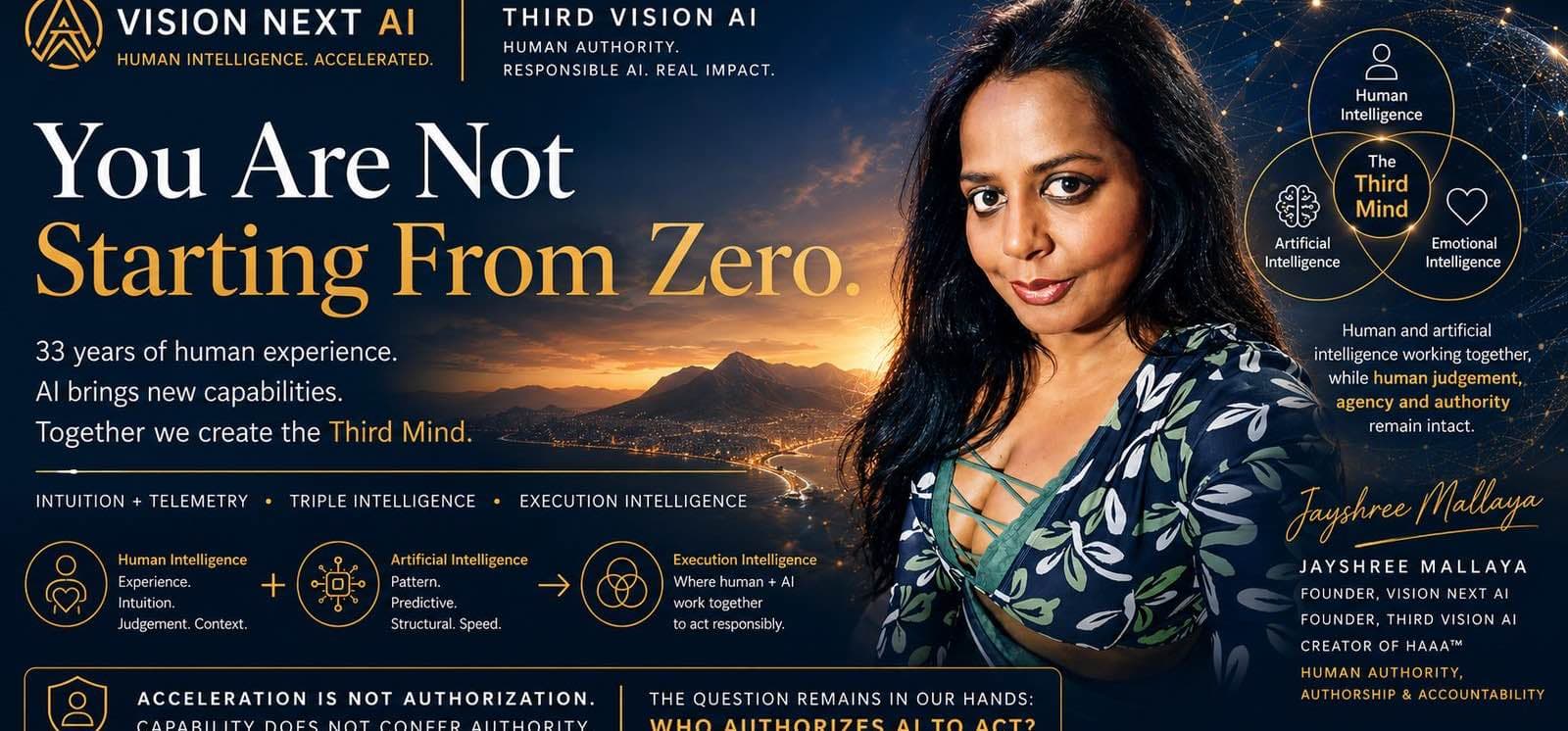
You Are Not Starting From Zero: Exploring human intelligence, hybrid intelligence and our responsibility in shaping the future of AI.
AI is an accelerator of human intelligence.
On 17 August 2025, I encountered AI for the first time.
I knew nothing about prompts.
I hadn’t watched tutorials. I hadn’t studied prompt engineering. Nobody had taught me the “right” way to communicate with AI.
I simply started having a natural conversation.
But I wasn’t starting from zero.
I brought 33 years of experience through Mystic Sisters, the business I co-founded with my sister, Mellissa Mallaya Pandya, and decades of coaching and working with people from everyday walks of life through to executives and C-suite leaders.
For more than three decades, I had listened to people navigate businesses, careers, relationships, uncertainty, difficult decisions and change.
I had watched people make choices when the answer wasn’t obvious.
I had learned to listen not only to what someone was saying, but sometimes to what they were struggling to articulate.
I brought lived experience.
Intuition.
Gut instinct.
Judgement.
Context.
Emotional intelligence.
Operational intelligence.
Thousands of conversations, observations and decisions.
AI brought something different.
Pattern intelligence.
Predictive intelligence.
Structural intelligence.
Computational capability.
Speed.
And something happened that fascinated me.
AI wasn’t thinking for me. It was adding structural intelligence to my thinking.
I would bring an idea, a question or a plan.
AI could help me structure it, examine it, challenge assumptions and identify connections I hadn’t yet articulated.
But the idea was still mine.
The lived experience was mine.
The intuition was mine.
I could question what came back, disagree, add context, change direction and decide what happened next.
That first conversation began changing how I understood intelligence itself.
We Carry More Intelligence Than We Realise
Human beings don’t arrive at AI as empty vessels waiting for a machine to make us intelligent.
We arrive with intelligence already inside us.
Our experiences teach us.
Our mistakes teach us.
Our professions teach us.
Our families and communities teach us.
Our cultures shape how we interpret the world.
Our intuition can alert us to patterns before we have the language or evidence to explain what we are noticing.
Over a lifetime, we accumulate knowledge through thousands of small experiences.
AI brings a different set of capabilities.
It can identify patterns across large amounts of information.
It can make predictions.
It can structure information.
It can retrieve and process information rapidly.
It can help us examine a problem from perspectives we may not have considered.
Neither form of intelligence needs to erase the other.
The opportunity is in understanding what happens when they work together.
That became the foundation of my thinking around the Triple Intelligence Framework™:
Human Intelligence + Artificial Intelligence → Execution Intelligence
Human Intelligence brings lived experience, intuition, judgement, intent, context and emotional intelligence.
Artificial Intelligence brings computational, predictive, pattern and structural capabilities.
Execution Intelligence emerges as we bring those capabilities together to structure and shape thinking toward intentional action.
But before execution, something else happens.
A space emerges between human thought and artificial intelligence.
I call that the Third Mind.
The Third Mind
The Third Mind is not AI replacing your mind.
It is the hybrid intelligence space that can emerge when human experience, intention and judgement interact with the structural, computational and pattern capabilities of AI.
You bring something.
AI brings something.
You question what comes back.
You refine it.
You disagree.
You add context the machine didn’t have.
You recognise a pattern.
You change direction.
An idea can gradually take a shape that neither your original thought nor the first AI response contained on its own.
That is what I experienced in those early conversations.
The human doesn’t disappear from the relationship.
The human becomes an active participant in hybrid intelligence.
And that distinction matters.
You Are Your Biggest Prompt
A few days after my first encounter with AI, I started seeing posts about prompts everywhere.
Prompt engineering.
Prompt libraries.
Perfect prompts.
I found it fascinating because I hadn’t learned any of them.
I had simply communicated naturally.
Then I realised something:
I was my own prompt.
My 33 years of experience were part of the prompt.
Thousands of conversations were part of it.
My intuition was part of it.
My questions were part of it.
My understanding of people and businesses was part of it.
Everything I had learned from real-world problems entered that conversation with me.
AI didn’t give me those 33 years of intelligence.
It gave me a new way to structure and accelerate what I already carried.
Those decades were not a detour from technology.
They were part of the human intelligence I brought into it.
And this is one of the messages I want people entering the AI era to understand:
You are not starting from zero.
You are arriving with a lifetime of intelligence.
Lived Experience Is an Innovation Asset
This is why I believe lived and domain experience may become increasingly valuable in the AI era.
A filmmaker understands filmmaking in ways that come from years on sets, working with actors, budgets, schedules and creative constraints.
A nurse carries patient-care knowledge accumulated across countless human interactions.
A teacher can notice changes in a classroom that no dataset fully captures.
A logistics operator knows what happens when a perfectly designed process meets traffic, weather, people, deadlines and real-world uncertainty.
A farmer understands land, seasons and local conditions.
An entrepreneur carries memories of customers, failures, opportunities and decisions.
A community holds cultural and contextual intelligence that may never appear in a global dataset.
Technical expertise remains essential. Engineers, researchers and builders turn ideas into systems.
But domain expertise can help us understand which problems are worth solving, why they matter and how solutions will encounter the real world.
AI doesn’t erase your experience.
It gives your experience another way to become useful.
After 33 years of working with people, I don’t see AI as making accumulated human intelligence obsolete.
Used responsibly, it can give decades of experience new capabilities, almost like giving our accumulated human intelligence superpowers.
What Vision Next AI Is Really About
This insight became part of why we created Vision Next AI.
Vision Next AI isn’t simply about teaching people how to use AI tools.
It is about helping people recognise the intelligence they already possess and learn how to bring it into a hybrid intelligence environment.
I want the person who has spent 30 years building a business to understand that their experience hasn’t suddenly become irrelevant because AI arrived.
I want the teacher to understand that years spent reading a classroom matter.
I want the frontline worker to recognise the value of operational knowledge.
I want the young person encountering AI for the first time to know that curiosity and critical thinking matter more than memorising a perfect prompt formula.
And I want the person looking at AI and thinking, I’m too late, to hear this:
You are not starting from zero.
You are arriving with everything life has already taught you.
Vision Next AI is about helping people discover how to work with AI without believing they first have to think like a machine.
It is about communication.
Critical thinking.
Human agency.
Hybrid intelligence.
Understanding when to question an AI response.
Recognising what human context may be missing.
And learning how to combine what we know with what technology can reveal.
Not humans becoming more like machines.
Humans becoming more capable while remaining human.
Intuition + Telemetry
This is also why we are developing what I describe as the Intuition + Telemetry Onboarding Protocol™.
For decades, experienced people have said:
“Something doesn’t feel right.”
“I know my customers.”
“I’ve seen this pattern before.”
“I think we’re going to have a problem.”
We call it intuition or gut instinct.
Sometimes it can reflect accumulated pattern recognition from years of lived experience.
But intuition shouldn’t automatically override evidence.
And data shouldn’t automatically dismiss human intuition.
Instead, we can bring them together.
Intuition + Telemetry.
You bring the human signal.
Technology brings observable evidence.
Sometimes the data supports your instinct.
Sometimes it challenges it.
And sometimes the gap between the two reveals the question nobody was asking.
A dashboard isn’t your intelligence.
It is a tool that can help you test what your intelligence may already be noticing.
AI can help connect those signals at speeds that were previously difficult to achieve.
This is where hybrid intelligence becomes practical.
From the Third Mind to Execution Intelligence
Thinking together is one thing.
Eventually, thinking becomes action.
You bring a plan.
AI helps you structure it.
You test assumptions.
Explore alternatives.
Identify gaps.
Add context.
Refine the plan.
Then comes execution.
This is where Execution Intelligence becomes important.
Execution Intelligence brings human and artificial intelligence toward intentional and responsible action.
But there is a boundary.
AI helping shape a decision does not automatically give AI authority to execute that decision.
Acceleration is not authorization.
Intelligence is not authority.
And as AI moves from systems that answer questions toward agentic systems capable of initiating actions, that distinction becomes increasingly important.
It led me to the question at the centre of our work at Third Vision AI:
Who authorizes AI to act?
And it is why our work on HAAA™, Human Authority, Authorship & Accountability, focuses on preserving legitimate human authority as AI becomes increasingly capable of real-world action.
From Architecture Into Live Operations
These ideas are now moving from philosophy and architecture toward live operations.
As we prepare for a pilot deployment with SK Crystals and AAA Logistics, together with our technology team at VectoRise, we have an opportunity to observe these principles in a real operational environment.
Humans.
AI.
Vehicles.
Telemetry.
Policies.
Workflows.
Operational systems.
Changing conditions.
The pilot isn’t simply about asking:
Does the technology work?
We also want to understand what happens to human judgement, authorship, authority and accountability as intelligence approaches execution.
Can AI contribute to operational decisions without inheriting the authority of the humans and institutions responsible for them?
Can legitimate authority remain identifiable when an AI-assisted decision becomes a real-world action?
What happens when information is incomplete?
When conditions change?
When human and machine signals disagree?
When an action should not proceed?
These questions matter because agentic AI changes what an enterprise pilot needs to prove.
Success cannot only mean that the system executed correctly.
Sometimes HALT may be evidence that governance worked.
Sometimes DENY may be the correct outcome.
The question is no longer only whether an AI-generated action is intelligent.
It is whether that action is admissible and authorized.
Why I Open Sourced the Third Mind
I chose to open source the Third Mind concept for a simple reason.
I want humanity to benefit.
Hybrid intelligence shouldn’t become a privilege available only to technologists, large corporations or people who know how to write sophisticated prompts.
A farmer has intelligence.
A teacher has intelligence.
A nurse has intelligence.
A small business owner has intelligence.
A grandmother has intelligence.
A young person has intelligence.
A frontline worker has intelligence.
A community carries intelligence.
Imagine what becomes possible when billions of people recognise the intelligence they already possess and learn how to work responsibly alongside artificial intelligence.
That is much bigger than productivity.
It is human capability.
Eight Billion Stewards
AI is here to stay.
Like the internet, email and mobile phones, it will increasingly become part of how we communicate, work, learn, create and make decisions.
The question isn’t whether humanity will interact with AI.
It is how.
There are more than eight billion of us sharing this world.
I believe each of us has a role in stewarding the future we build with AI.
That doesn’t mean responsibility is distributed equally.
Developers have responsibilities for the systems they build.
Companies have responsibilities for what they deploy.
Governments and policymakers have responsibilities for the environments they govern.
Boards and executives have responsibilities for the autonomy they authorize.
But individuals also have a role.
We can learn.
We can question.
We can disagree.
We can challenge confident answers.
We can bring our lived experience into the conversation.
We can protect human dignity, agency and freedom.
And we can insist that technologies capable of acting in our world are governed responsibly.
This is what Vision Next AI means to me.
Not another course about prompts.
A movement toward human capability in the age of hybrid intelligence.
Helping people recognise their own intelligence.
Helping them develop their Third Mind.
Helping them bring intuition together with evidence.
Helping them move ideas toward Execution Intelligence.
And helping them understand the boundary between intelligence and authority.
The Question Remains in Our Hands
When I think back to 17 August 2025, what strikes me most is how ordinary the beginning was.
I didn’t enter a laboratory.
I didn’t write code.
I didn’t study a manual.
I had a conversation.
I brought 33 years of human experience to an intelligence I had never encountered before.
And through that interaction, I began discovering something about AI.
But I also began discovering something about ourselves.
We carry far more intelligence than we sometimes recognise.
None of that becomes obsolete because artificial intelligence has arrived.
AI can help us think.
It can help us structure.
It can help us discover patterns.
It can help us build.
It can give decades of human experience new capabilities.
But as intelligence moves toward autonomous action, we must preserve the distinction between capability and authority.
We are not handing our power to AI.
You are not starting from zero.
You are arriving with a lifetime of intelligence.
AI may accelerate what humanity is capable of.
But the future it helps create has not been decided for us.
The question remains in our hands:
Who authorizes AI to act?
Because every life counts.
Every voice matters.
And every one of us has a role in stewarding the future we build with AI.
- Technology
- Leadership
- Education
- Becoming Me
- Stronger Together
- Our Impact
- Global