
Why We Want More Nelson Mandelas in Our World?
Jul 19, 2026
story
Seeking
Visibility
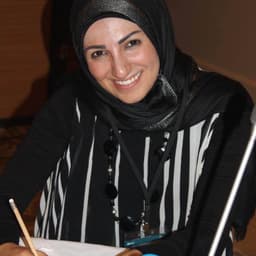
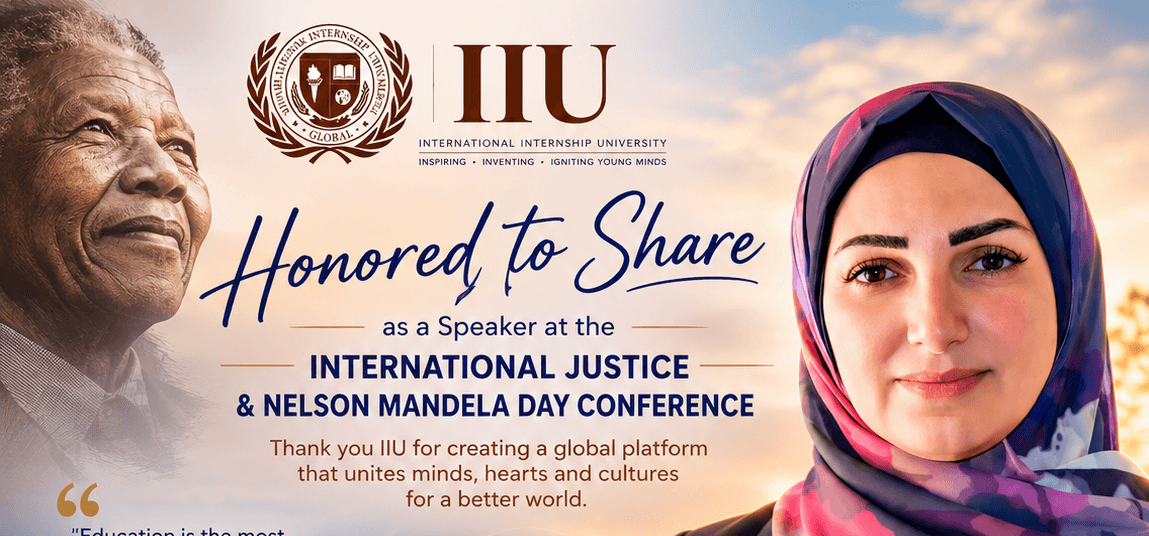
From Lebanon to the World: If We Need More Nelson Mandelas, We Must Raise Them
By Hawraa Ghandour
When I was invited to speak at the International Justice & Nelson Mandela Day Conference organized by the International Internship University (IIU), I knew I did not want to give another speech about history.
I wanted to speak about responsibility.
As a Lebanese educator, I come from a country where war is not just a chapter in a textbook. It is a lived experience. It has interrupted children’s education, displaced families, and left emotional wounds that cannot always be seen.
Yet despite everything, I have witnessed something extraordinary.
I have seen teachers who refused to close their classrooms, parents who refused to give up on their children’s future, and students who continued dreaming, even when hope seemed distant.
Standing before an international audience, I realized that Nelson Mandela’s greatest legacy is not something we simply commemorate once a year. It is a responsibility we carry every day.
The question is no longer, “Who was Nelson Mandela?”
The real question is:
“How do we create more people like him?”
My answer was simple.
We stop waiting for another Mandela to appear, and we begin raising them.
As educators, our mission extends far beyond teaching mathematics, science, or languages. We are entrusted with something much greater—we shape values.
Every classroom is an opportunity to teach justice.
Every discussion is an opportunity to model respect.
Every conflict between students is an opportunity to demonstrate reconciliation instead of retaliation.
Every child is a potential peacemaker.
During my speech, I shared something that has become central to my work: deep listening.
Many of today’s conflicts persist not because people have nothing to say, but because too few people truly listen. We listen to reply, to defend ourselves, or to prove we are right. Rarely do we listen to understand.
I believe that deep listening is one of the most powerful acts of peacebuilding.
When children feel heard, they learn empathy.
When communities feel heard, they begin to heal.
When nations learn to hear one another, dialogue becomes possible.
Justice is not only created in courts. It is built in classrooms, in homes, and in the everyday choices we make.
One message from my speech seemed to resonate deeply with the audience:
“If the world needs more Nelson Mandelas, then our classrooms must become the places where they are raised.”
I truly believe this.
The next great leader may not yet know their own potential.
Perhaps they are the quiet child sitting in the back of a classroom.
Perhaps they are a student who simply needs one teacher to believe in them.
Perhaps they are growing up in a country experiencing conflict, just as many children in my own country are today.
As educators, we may never know whose life we are changing.
But every lesson rooted in compassion, every act of fairness, every moment of encouragement plants a seed that may one day transform a family, a community, or even a nation.
Representing Lebanon on this global platform was both an honor and a responsibility.
I wanted the world to see not only our struggles, but also our resilience.
I wanted them to know that despite conflict, Lebanon continues to produce educators who believe in peace more than violence, dialogue more than division, and hope more than despair.
My gratitude goes to the International Internship University for creating a global space where people from different countries, cultures, and beliefs can come together as one learning community.
In a world increasingly divided by conflict, we need more places that connect minds, hearts, and cultures.
Nelson Mandela’s legacy does not belong to South Africa alone.
It belongs to every teacher who chooses compassion.
To every young person who stands for justice.
To every leader who serves humanity before personal interests.
And to every ordinary person who believes that a better world is still possible.
Today, I leave with one conviction stronger than ever:
Peace is not inherited. It is educated.
If we want future generations to live in justice, dignity, and harmony, then we must begin where every lasting change begins—
in our classrooms, in our communities, and in our hearts.
#WorldPulse #NelsonMandelaDay #Lebanon #EducationForPeace #DeepListening #WomenLead #SocialJustice #GlobalCitizenship #Peacebuilding #Educators
- Human Rights
- Education
- Global