
Review: My Honest Experience Using Softaken PDF Numbering Software for Office Documents
Jul 23, 2026
first-story
Seeking
Visibility


About
We process thousands of PDF files monthly in our consulting office, such as invoices, contracts, project reports, proposals, HR documents and compliance records. Most of these files are shared with clients, auditors and internal departments so it is important to have the correct page numbers. Unfortunately, because many PDFs were created by different employees and software applications, page numbers are often missing, inconsistent, or placed incorrectly.
In a single quarterly audit, our documentation team discovered pagination problems in more than 4,850 PDF files. These files were manually corrected, which delayed document verification by nearly three working days. We needed a reliable method for adding page numbers without changing the original document content.
Information
Organization Type: Consulting Office
Primary PDF Volume: 4,850 PDFs
Total Pages Numbered: 126,214 pages
Processing Time: 46 minutes
Operating System: Windows
What I Have Trouble With
The document management process became more and more difficult with the growing number of PDF files.
- Approximately 4,850 PDFs were requested for page numbering.
- Almost 126,000 pages needed sequential numbering.
- Manual editing required more than 32 staff hours per month.
- Some client reports had inconsistent page numbering.
- Printing errors due to page references not matching.
- Lack of page identifiers slowed down the audit preparation.
The main purpose of our work was to provide all PDFs with the same page numbering, but without changing the original formatting and quality of the documents.
Why is PDF numbering important?
Page numbering is an indispensable part of document management. Well-numbered PDF files help in navigation, make referencing between documents easier, reduce printing errors and make large files easier to review.
The main benefits include:
- Better organized documentation
- Simpler navigation
- Fast document verification
- Improved audit preparation
- Professional presentation of documents
- Fewer errors in printing
Manual Methods
Manual Method 1: Using the Adobe Acrobat Header & Footer Tool
The first method was to use Adobe Acrobat's Header & Footer feature to insert page numbers.
Results
It worked fine for single documents. But if you tried to process thousands of files one at a time, the process became very slow.
Manual Method 2: Conversion using Microsoft Word
The second method was to convert the PDF files to Microsoft Word, insert the page numbers and convert back to PDF.
Result
This worked well for simple documents but many complex PDFs were reformatted after conversion.
Method 3 Manually: Print to PDF with Numbers
Some documents were re-created by print workflows that supported page numbering.
Result
We were only able to successfully process a few PDFs, and the print quality was inconsistent.
Tool-based Approach
After searching all the options, I found Softaken PDF Numbering Software as the best tool to add page numbers to PDF files without affecting the original content and format.
Outcome Based on Tool
The software managed to process all 4,850 PDF files (some 126,000 pages) in around 46 minutes.
Final Results:
Processed PDF Files: 4,850
Total Pages Numbered: 126,214
Processing Time: 46 Minutes
Numbering Accuracy: 100%
Formatting Retained: 100%
Processing errors: 0
Printing errors: 0
Manual Correction Required Documents: 0
Time Saved Per Month: About 30 Hours
The increased consistency reduced the document preparation time and eased internal reviews.
Advantages
Bulk PDF Processing: In a single run, thousands of PDF documents were processed, eliminating the repetitive manual work.
Maintains original formatting: Page numbering was added without changing fonts, layouts, images, or tables.
Numbers in the right position: The numbering appeared consistently on every page in the selected position.
Quick Processing: Over one hundred thousand pages done in less than an hour.
Works with Large Document Collections: The application processed thousands of business PDFs without any performance problems.
Easy-to-Use Interface: The simple workflow meant that office staff could do the job with no technical expertise.
Enhances Audit Readiness: Documents that were well-numbered made checking documents during compliance reviews easier.
Saves Time on Operations: Automation cut monthly documentation work by nearly thirty staff hours.
Limitations
Windows Platform Only: The software is intended for Windows operating systems.
Do Not Open PDF Files: Processing should be done with the documents closed to avoid file access conflicts.
Required License Version: The trial version is for evaluation only, a paid license is required for complete business processing.
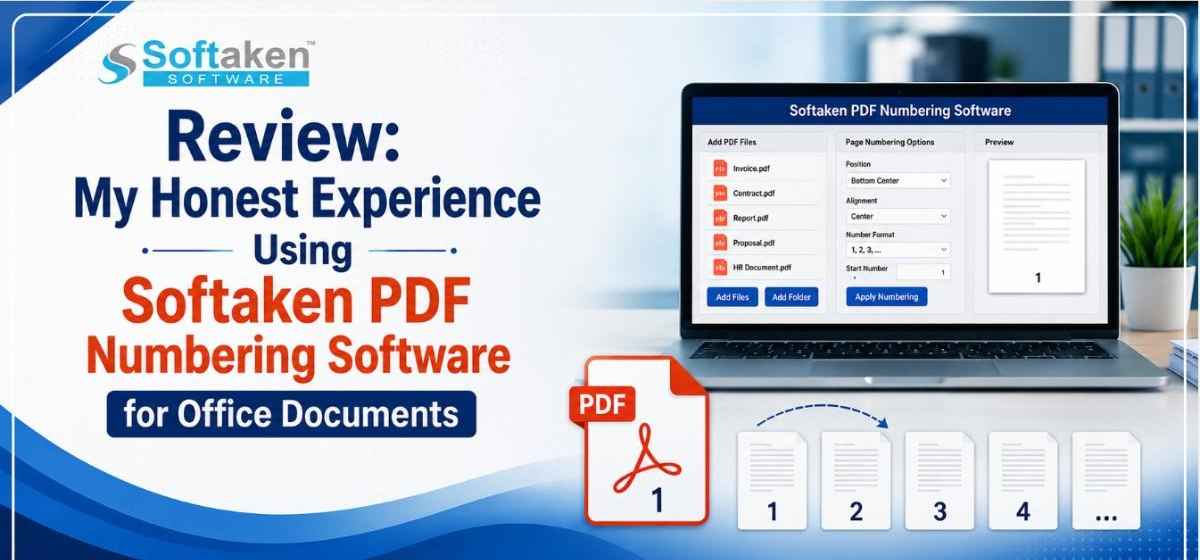
Steps of the Tool-Based Method
- Install the software on a Windows PC.
- Launch the application.
- Add individual PDF files and/or folders.
- Choose a page numbering format you want.
- Select page position and alignment.
- Choose the font size and numbering style.
- Choose the destination folder.
- Begin the numbering process.
- Complete the process.
- Review the numbered PDF files.
Best Practices
Safer Processing Tips
- Make a backup of important PDF files.
- Check the page numbering settings before doing a bulk process.
- Save output files in a different folder.
- Review some documents after completion before distribution.
- Adequate disk space for processing.
Points to Remember
- Ensure all PDF viewers are closed prior to starting.
- Confirm page number position.
- Do not terminate the processing task.
- Keep software updated.
- Try out the settings on a small batch before processing thousands of files.
Target Audience
This solution is perfect for:
- Administrative Assistants
- Advocates
- Accounting departments
- HR groups
- Educational institutions
- Government organizations
- Documentation experts
- Printing firms
Users are going to enjoy the benefits of consistent document organization, faster audits, a more professional presentation, and significant savings in time.
FAQs
What was the significance of page numbers in this case study?
Proper numbering improved document organization, navigation and audit readiness.
Did the page numbering affect the way the document was formatted?
No. The original layout and content were not changed.
How many PDFs were processed?
4,850 PDFs, more than 126,000 pages.
Were any documents subsequently corrected by hand?
No, each processed document was ready to use straight away.
Can this be used in business environments?
Yes. It’s especially useful for organizations that manage large volumes of PDF documentation.
Conclusion
This review shows why manual numbering of PDF pages is impossible when dealing with thousands of business documents. The automated solution processed 4,850 PDF files, totaling more than 126,000 pages, preserved document formatting, eliminated pagination errors and reduced monthly documentation time by almost 30 hours.
Based on my experience, I would recommend this solution to businesses, law firms, educational institutions, accounting firms and IT administrators who regularly work with large PDF collections. The software is only for Windows and needs a commercial license to use without restrictions. But these are minor limitations compared to the speed, accuracy, ease of use and reproducibility of results.
Overall Performance Rated 4.7 out of 5
- Technology
- First Story
- Member Introductions
- Shout Your Vision
- Digital Skills
- Global