
One Ground, Four Generations
Jul 25, 2026
story
Seeking
Connections
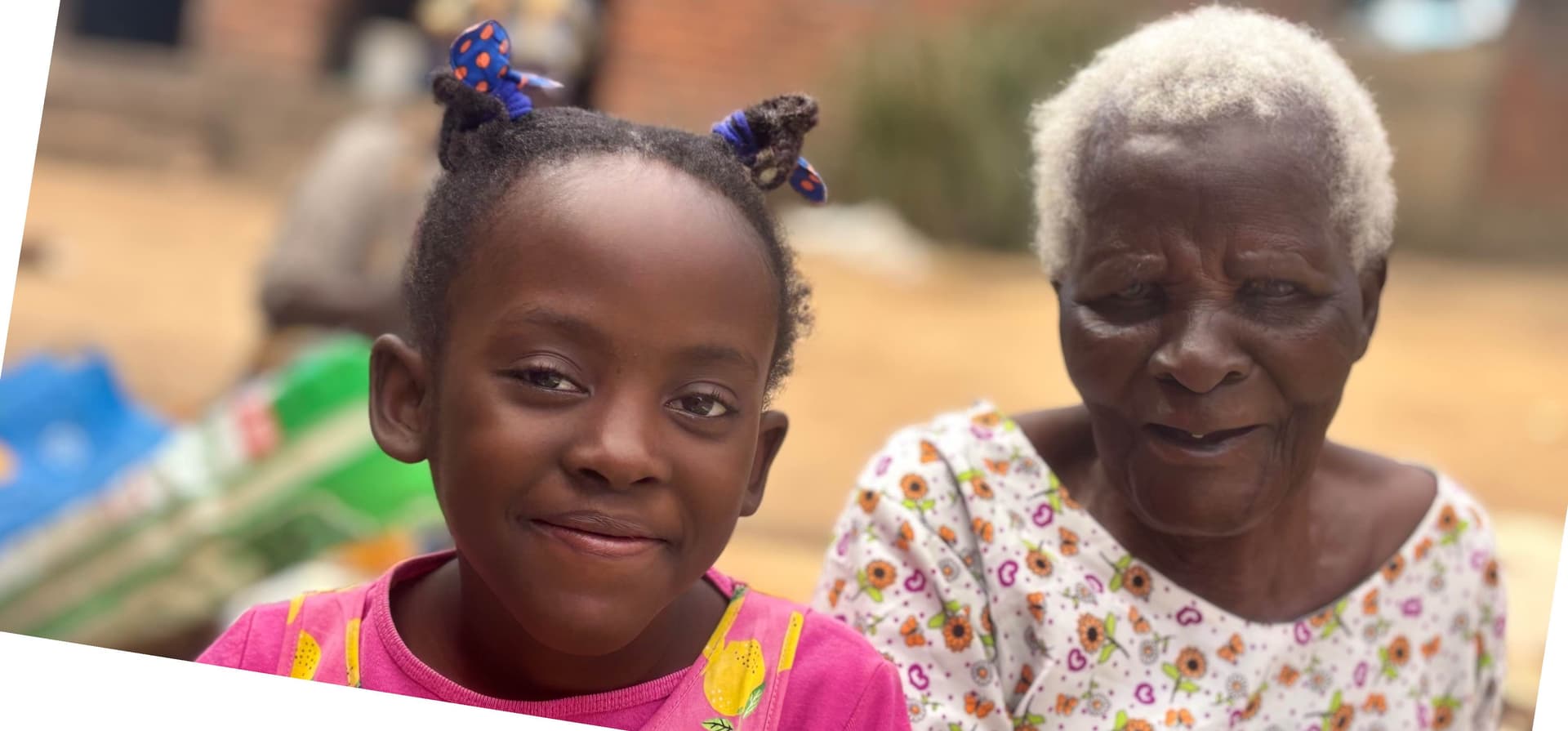
Photo Credit: Save the Village Youth Foundation
Four generations apart, one ground beneath them. Ntcheu District, Malawi.
Before she could walk steadily on her own, my daughter already knew how to stand still beside her elders. Not because anyone taught her to. She simply watched, and copied, the way children do the same way I once watched my great-grandmother, and the way she, decades before me, must have watched someone else.
There is a photograph of the two of them my great grandmother, silver-haired and steady eyed, and my daughter, small in her pink dress, hair tied up in bows sitting together in the sun outside our home in Malawi. I took the photograph, but I am also the middle of it: the generation standing just outside the frame, holding the thread between the two people in it.
My great grandmother has lived through more seasons of hardship and harvest than I can count droughts that emptied the granaries, years when the rains came too late or too hard, decades of watching her daughters and granddaughters carry water, till land, and raise children of their own. She never had a platform. No one asked her opinion on climate policy or gender equity. But she survived, and more than that, she taught quietly, through her hands, through the way she never let hardship harden her toward the people around her.
I founded Save the Village Youth Foundation because of women like her. Long before I had language for it "climate resilience," "gender responsive policy," "grassroots leadership" I watched her practice it. She adapted. She shared what little she had. She showed up for other women in the village without being asked, because that was simply what women did for each other. It was not activism to her. It was survival, and it was love, and it turned out to be both.
Today my work takes me into rural communities across Malawi and into policy conversations across the Arab Africa Council for Integration and Development, where I try to carry the voices of women like my great grandmother into rooms they will never enter themselves. I use participatory storytelling because I learned, from her, that the knowledge of rural women is not a footnote to development it is the source. She knew the land. She knew her neighbors. She knew, decades before it had a name, what it meant to build resilience from almost nothing.
My daughter does not yet know what her elder survived. She does not yet know what climate justice means, or why her mother spends so many hours away from home in meetings about gender equality and youth empowerment. But she already knows how to stand next to her elder without being told. She already belongs to a line of women who take care of each other, whether she has the words for it or not.
That is what the photograph holds, when I look at it now not a metaphor, but a fact: four generations, two of them visible in the frame, standing on the same ground my great grandmother has stood on her whole life. The girl in the pink dress and the woman who has never left the village are not two separate stories. They are the same story, told at different points along the same patch of inherited ground.
I think of them often when I think about what it means for women to lift each other up not as a slogan, but as something that happened generations before any of us had words for it, and never stopped. That is how it survives long enough to change anything: not one voice, but a line of women who keep handing the thread to the next pair of hands.
But a thread only survives if someone deliberately keeps hold of it, and right now, too much of what my great-grandmother knows lives only in her hands and in the memories of the women who watched her nowhere else. It has never been written down. It has never been taught in a structured way. It has simply been absorbed, generation by generation, the same way my daughter absorbed how to stand beside her without being told. That method has worked for a long time. But it depends on proximity, on girls growing up close enough to their elders to watch them, and in a world where migration, climate displacement, and changing family structures are pulling young people away from their villages faster than ever, I am not willing to trust an inheritance this valuable to chance alone.
This is why I am building a deliberate bridge between these two generations of women not to replace what happens naturally between a grandmother and a granddaughter, but to protect it, formalize it, and extend it to girls who may not have an elder standing beside them at all. I am pairing elder women across the communities where the Foundation already works with young girls and adolescent mothers, over a full season, so that knowledge of drought survival, seed saving, and land is practiced hand to hand, not simply remembered. I am training young women from these same villages to lead this work themselves, so it does not depend on me, or on any single outside organizer, to keep functioning. And I am feeding what these girls learn directly into the Foundation's climate-smart agriculture and leadership programs, so the wisdom of women like my great-grandmother is not only preserved, but actively shaping the resilience of the generation coming after her.
The photograph shows two generations sitting together in the sun. What I am building is the structure that ensures every girl like my daughter has that same ground to sit on not by accident, but because someone made sure of it.
Because survival should not be left to luck, especially now, as rains grow harder to predict and droughts last longer. The knowledge held by elder women about land, water, and survival matters more than ever. It should not depend on luck or location. It should be steady, expected, and guaranteed for all.
- Stronger Together
- Global