
INDIA: Climate Change Has Reached My Home in the Hills
Jul 21, 2026
story
Seeking
Encouragement


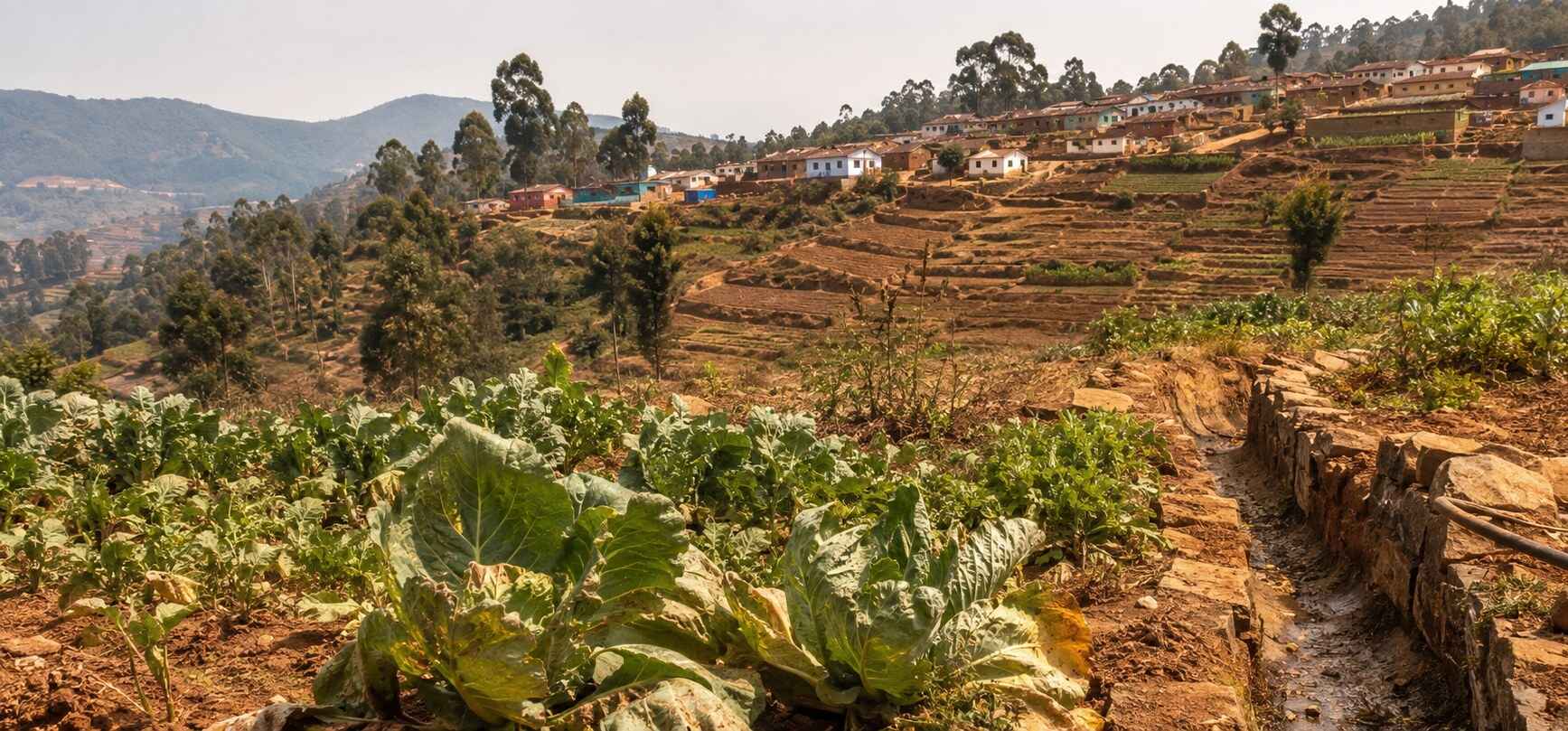
The visual is based on recent reporting of intense Nilgiri drought unusually high temperatures, dried water bodies, and damaged crops. his is an AI-created representative image, not a documentary photograph of a specific Nilgiri village.
Each summer, Sindhu Sathya Narayanan leaves Chennai for her family home in the Nilgiri Hills. On her latest visit, the cool refuge of her childhood no longer felt the same, revealing how rising heat and unreliable rain are affecting farms and rural women.
“Something has shifted, not instantly but slowly. Something once vivid is gradually dimming.”
My hometown is in the hills. It is where my home is, and where my past lives.
What truly sets it apart is its deep connection to nature — hills and valleys, wildflowers and birds, clear streams and grass — which makes it a very healthy place to live.
Beyond its breathtaking landscapes, the region has been home to more than 70,000 small and marginal farmers.
Agriculture is passed down through generations with care and precision. The people in the hills are responsible environmental stewards too.
Our land, our pride.
We live in harmony.
I am Sindhu, from a small village in Nilgiri Hills, Tamil Nadu, India. I currently live in Chennai, 558 kilometers away from my hometown. To escape the summer heatwaves, people travel to hill stations, and I am lucky I get to return to my home in the hills.
Recently, when I visited my hometown, the region spoke to me through its rising temperature. Outside, the hot air blew in my face, small streams ran dry, and native plants — rarely seen now — couldn't withstand the extreme heat.
I was born and brought up in a small village tucked away in the hills of the Nilgiris. My village is small but orderly, surrounded by greenery. Almost all the villages in the Nilgiri hills were set in the same picturesque surroundings. Most of our houses are similar in construction. They are built in rows, share a single wall, face east, and have low roofs, providing shelter through every season.
This time I entered the home, and it felt very stuffy. My mother said they had never experienced such a temperature rise before. It was difficult to stay near the hearth, and the heat now continued from day into night. Water scarcity and climate stress added to the strain. Some families had bought electric fans, something I had never seen in hill homes before.
I was also shocked to see that the green vegetables in our kitchen garden did not look so green. My aunt told me that rain usually washes pesticide spray, environmental residue, and dust from the leaves. Since there's been no rain and the monsoon is delayed this year, everything looks less fresh. She also told me it was tough to get water through irrigation because the entire village shares the same borewell. Everyone has fewer turns to water their farms, and yields are lower. It's tough to prepare the drought-hit soil for sowing too. My 98-year-old grandmother, who has held four generations together through farming, said that farming activities would usually be in full swing by May. Now, they face potential losses.
Climate change has also made these challenges harder. Some of the women's self-help groups — the silent change-makers building steady rural income — are losing their income due to failing crops and a deficit in summer rain.
In my village, what is conspicuous is that most of the strenuous work is done by women. Crops have to be sown and tended so there is enough to store for the family's future use, while a substantial quantity must be kept aside as seeds for the next season. Crop rotation was the norm. This is how they lived, rarely complaining and accepting their lot as others before them had. Now the change in weather patterns has affected their seasonal crops, sowing, harvesting, yields, and future savings.
The land, which survived landslides, heavy rainfall, and floods, is now experiencing a scarcity of rain. I am left grappling with the fact that I can never truly go back in time, even if I physically return to the place I grew up. Something has shifted, not instantly, but slowly. Something once vivid is gradually dimming.
Rising heat in the hills, insufficient summer rain and a delayed monsoon are raising serious concerns, yet they receive little public attention. Greater efforts are needed to create awareness and outreach programmes that help farmers and rural women understand seasonal weather trends and prepare accordingly.
Policymakers need to pay closer attention to monsoon variability and take necessary action to manage water needs and irrigation.
This change in weather should serve as a wake-up call for policymakers, institutions, and communities to pay greater attention to protect current and future generations.
Thinking about climate change can be overwhelming. We've been aware of its causes for decades now, and all around us we bear witness to its devastating effects on our community and ecosystem.
The climate crisis does not affect everyone equally. Women and girls in rural areas face disproportionate impacts from climate change, largely because they make up the majority of the world's poor, who are highly dependent on local natural resources for their livelihoods.
Given their position on the front lines of the climate crisis, women are uniquely positioned to be agents of change, leading the way in mitigating the causes of global warming and adapting to its impacts on the ground.
For this potential to become meaningful action, women and girls need the resources, opportunities, and decision-making power to lead. There are three key reasons why empowering women and girls is essential to climate action. First, women are environmental stewards. Second, they are the backbone of community resilience. Third, they are agents of change. It is time to invest in women and support their leadership in building a more sustainable future.
It's time to invest in women as a strong force for change, leading the way to a more sustainable future — one that also means learning how to live safely, process our losses, and even thrive on an already-changed planet.
Adaptation strategies can vary widely, depending on the specific needs of the community. Enhancing the safety of workers grappling with extreme heat on the job, for example, will require widespread occupational heat standards.
People facing increased wildfire risks should have access to air filters for their homes and public smoke shelters in their communities. Elected officials must also address our home insurance crisis and improve the voluntary buyout programs that help people move to higher ground. Governments need to integrate adaptation needs like these into policies, programmes and investments to create resilient communities amid the climate crisis.
Through World Pulse, I am raising my voice about this crisis.
STORY AWARDS
This story was published as part of World Pulse's Story Awards program. We believe every woman has a story to share, and that the world will be a better place when women are heard.
- Environment
- Climate Change
- Featured Stories
- Global