
Case Study: How an International Company Completed a Secure EML to PST Migration
Jul 21, 2026
story
Seeking
Visibility


Overview of the Case Study
A global engineering company with operations in Germany, India, Canada and Australia made the decision to switch all of its staff to Outlook on Windows in order to standardize its email environment. While the headquarters used Outlook PST files, a number of regional teams used email programs that stored messages in EML format.
The Senior Messaging Administrator and Global IT Infrastructure Manager oversaw the migration project. They were tasked with moving almost 215,000 EML files that were gathered from 340 employee mailboxes while preserving attachments, sender information, timestamps and folder hierarchy.
Project Statistics
- Workers Involved: 340
- EML Files: 215,480
- Total Email Data: 612 GB
- Project Deadline: 5 Days
- Countries: 4
- Largest Mailbox: 18.6 GB
Requirement of EML to PST Conversion
During the company's infrastructure update, a number of operational issues emerged, necessitating the move.
The IT division determined:
- Different email clients were being used by staff members.
- Outlook was unable to open archived EML folders directly.
- Importing emails by hand took up a lot of working hours.
- During testing, the folder hierarchy was altered.
- Occasionally, attachments were lost.
- A uniform mailbox format was required for several regional offices.
- Outlook-compatible archives were mandated by compliance standards.
Because of these problems, a secure migration was necessary prior to company-wide adoption.
Tested Manual Methods
1. Drag-and-drop technique (with Microsoft Outlook)
EML files were first imported by the administrators by dragging them into Outlook folders.
Result: Approximately 5,800 emails were imported every hour. Small batches were successfully finished. The metadata was largely unaltered.
Failures: Outlook was often frozen by large folders. The folder structure needed to be manually recreated. It got quite slow to import thousands of files. Occasionally, attachments did not synchronize.
2. The Copy and Paste Technique
In the second attempt, each Outlook folder was manually opened before EML files were copied into it.
Result: Easy for a few hundred emails. No other software is needed.
Failures: For enterprise data, it takes a lot of time. Continuous user supervision was necessary. Repeatedly, duplicate emails showed up. The original timestamps of several messages were lost.
3. Outlook Import and Export Wizard (Following EML Import)
Administrators exported the mailbox into PST format after manually importing EML files into Outlook.
Result: Produced PST files that are compatible with Outlook. Fits mailbox sizes that are restricted.
Failures: Two distinct techniques were needed. A noticeably longer migration period. The uniformity of folders was impacted by human mistake. For more than 200,000 emails, it is not feasible.
Manual Migration Limitations
The IT division recorded a number of typical problems:
- It was estimated that the entire migration would take more than 78 working hours.
- Ongoing observation was necessary.
- The arrangement of folders became uneven.
- The size of the mailbox was increased by duplicate emails.
- Outlook regularly froze due to large mailboxes.
- The likelihood of missing attachments is high.
- It is challenging to replicate across hundreds of employee accounts.
The company's five-day migration deadline was not met by the manual process.
Tool-Based Approach
The IT team compared various methods and decided on TrustVare EML to PST Converter since it allowed for large-scale email conversion while maintaining mailbox integrity.
Result
The automated migration was successfully finished.
Final Outcomes
Migration Outcome: 215,480 EML files were converted in total.
Conversion Success: 215,470
Failed Files: 10 failed files (corrupted source files)
Total Time Spent Processing: Four hours and eighteen minutes
Folder Accuracy: 100%
Preserved Metadata: 100%
Preservation of Attachments: 100%
Duplicate Problems: None
User Downtime: Less than 25 minutes
Two days ahead of schedule, the IT team finished the deployment.
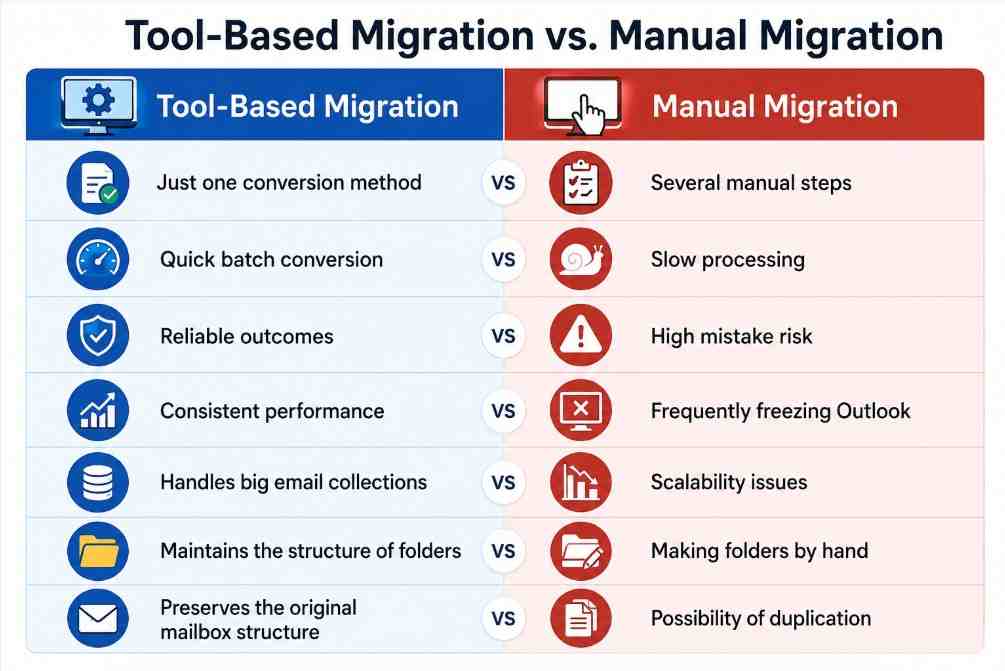
Tool-Based vs. Manual
Benefits of Tool-Based Methods
Conversion of Batch Emails: Reduces transfer time dramatically by processing thousands of EML files at once.
Maintains Email Metadata: Keeps track of email attributes, subject lines, timestamps and sender information.
Maintains Folder Organization: After conversion, the original mailbox hierarchy is preserved.
Large Mailboxes are Supported: Converts large email archives without dividing the project.
Integrity of Attachments: After migration, all attachments and embedded files are still accessible.
Easy-to-Use Interface: It is possible to finish the migration process without a high level of technical expertise.
Precise PST Output: Generates PST files that are compatible with Outlook and ready for use right away.
Reduces Time Spent on Administration: Minimizes human labor and frees up IT staff to concentrate on deployment instead of tedious importation.
Limitations
A Commercial License Is Needed: A license for unrestricted conversion must be purchased for the full version.
Depending on the Quality of the Source File: EML files that are corrupted might not convert properly.
Windows-Based Functionality: Organizations utilizing other operating systems need a compatible environment because the product is made for Windows platforms.
Pricing Information
The vendor provides a number of licensing choices that could change in the future.
Individual License ($69): Ideal for single users that require email conversion on a single PC.
Business License ($199): Made for businesses and IT divisions that need to install it on several business platforms.
Enterprise License ($299): Designed for businesses overseeing extensive deployments over numerous workstations with more expansive usage permissions.
Note: The cost of software varies from time to time. Before making a purchase, always check the official website for the most recent price, available discounts, and licensing terms.
Best Practices
Advice for a Secure and Safer Procedure
- Prior to relocation, make a full backup.
- Check for corruption in the source EML files.
- Prior to full deployment, test a small batch.
- Store the PST files that have been converted on a safe location.
- After migration, verify random mailboxes.
Things to Remember
- Before beginning the conversion, close Outlook.
- Make sure there is enough room for storage.
- Refrain from interfering with the conversion process.
- Before removing the original archives, make sure the converted folders are correct.
Who Should Use It?
This method works well for:
- Outlook migration projects are overseen by corporate IT administrators.
- Managed service providers handling client email migrations.
- Teams in charge of legal and compliance are keeping track of old correspondence.
- Companies switching to Outlook from email clients that support EML.
- Individual professionals who require safe archives compatible with Outlook.
These users gain from shorter migration times, mailbox integrity preservation and easier email administration.
FAQs
1. For what reason did the business convert EML files to PST?
The company wanted all employees to have direct access to old emails in Outlook.
2. Why did manual approaches fail?
They generated inconsistent results for large datasets and required a lot of time and regular monitoring.
3. After migration, were attachments kept intact?
Yes, during the conversion, all legitimate email attachments were preserved.
4. How many emails were successfully transferred?
Out of 215,480 emails, 215,470 were successfully converted by the project.
5. Was the folder hierarchy maintained throughout the migration?
Yes, after conversion, the original mailbox folder structure did not change.
6. Who gains the most from this solution?
Businesses, IT administrators and organizations who move big EML archives into Outlook reap the biggest rewards.
Conclusion
This case study shows that when repetitious manual labor is replaced by automation, business email migration becomes much more dependable. While the automated solution processed over 215,000 emails in just 4 hours and 18 minutes, maintained mailbox structure, maintained metadata accuracy and reduced user downtime, manual approaches were only effective for small datasets and required close supervision.
Businesses, enterprise IT teams, migration consultants and organizations contemplating Outlook adoption or long-term email archiving are advised to use this solution based on the quantifiable project results. The benefits such as speed, precision, batch processing and data integrity far exceed the drawbacks, even though a commercial license is needed and corrupted source files can still require attention.
- Technology
- Digital Skills
- Asia Pacific